Choosing the right career is not always about finding the highest-paying profession or following the most popular course. Sometimes, the answers are already hidden in your everyday experiences what you enjoy doing, problems you naturally solve, activities that make you curious and situations where you perform confidently.
A career storyboard is a simple self-reflection exercise that helps students connect these experiences and identify recurring patterns in their interests, strengths and motivations. It can become a useful starting point for career planning, especially when a student feels confused about what to pursue after Class 10 or Class 12.
What Is a Career Storyboard?
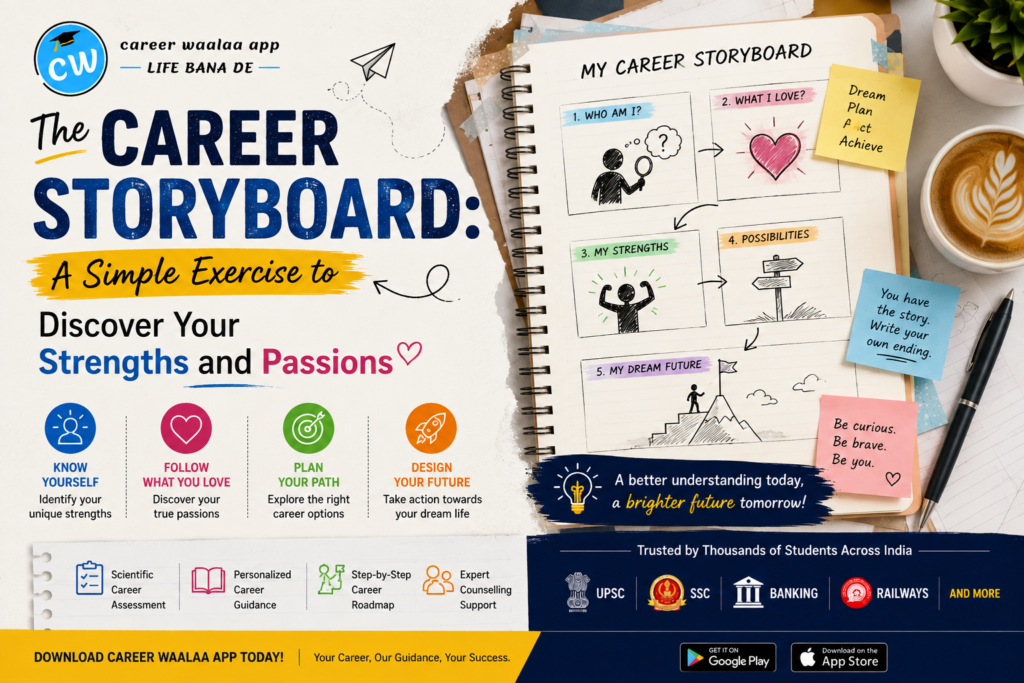
A career storyboard is a visual or written timeline of meaningful experiences from your academic and personal life. Instead of focusing only on marks, it asks you to look at moments when you felt interested, capable, motivated or proud of your work.
The objective is to identify patterns.
| Storyboard Element | Question to Ask |
| Interests | What activities do I genuinely enjoy? |
| Strengths | What do people often say I am good at? |
| Achievements | What accomplishments make me proud? |
| Challenges | What difficult situations have I handled? |
| Curiosity | What topics do I explore voluntarily? |
| Motivation | What makes me want to keep learning? |
When these answers are viewed together, they can provide useful clues about potential career directions.
Why Career Storytelling Can Improve Self-Awareness
Students often describe themselves using marks, subjects and examination results. While academic performance matters, it does not capture every ability.
For example, a student who organises school events may demonstrate planning and leadership skills. Someone who regularly creates videos may have creative and communication strengths. Another student who enjoys solving puzzles may demonstrate analytical thinking.
A career assessment can provide structured insights, while a storyboard adds personal context to those results.
How to Create Your Career Storyboard
Step 1: Divide Your Life Into Key Stages
Start with important periods of your academic and personal development.
You could use:
Primary School → Middle School → Class 10 → Class 11–12 → Current Interests
For each stage, write down activities, subjects, projects, competitions, hobbies or experiences that stood out.
Step 2: Record Moments You Enjoyed
Think about activities where you lost track of time or voluntarily invested extra effort.
Ask yourself:
- What did I enjoy doing without being forced?
- Which subjects made me curious?
- What hobbies do I return to repeatedly?
- What kind of projects interest me?
| Experience | Possible Clue |
| Designing posters | Creativity and visual thinking |
| Explaining topics to friends | Communication and teaching |
| Building projects | Practical problem-solving |
| Organising events | Leadership and planning |
| Analysing information | Research and analytical thinking |
| Writing stories | Communication and creativity |
These are not career predictions. They are clues worth exploring.
Step 3: Identify Your Strengths
Your strengths are not limited to academic subjects.
Consider technical, social, creative and personal strengths.
Strength Mapping Exercise
Create four categories:
| Strength Category | Examples |
| Academic | Mathematics, Science, Languages |
| Creative | Design, Writing, Visual Content |
| Social | Communication, Teamwork, Empathy |
| Practical | Organisation, Problem-Solving, Leadership |
Ask teachers, parents or trusted people what strengths they have noticed in you. Sometimes others identify abilities that you overlook.
Step 4: Find Your Passion Patterns
Passion is often misunderstood as one magical subject that you love immediately. In reality, interests can develop through exposure and experience.
Look for repeated patterns instead.
For example, if your storyboard repeatedly includes:
Technology + Problem-Solving + Curiosity + Building Projects
you might explore technology-related careers.
If it shows:
Communication + Creativity + People + Leadership
you could investigate marketing, management, media, education or other people-focused fields.
The purpose is career exploration, not instant career selection.
Step 5: Connect Strengths With Career Options
Once you identify patterns, start matching them with possible career areas.
| Your Pattern | Career Areas to Explore |
| Analytical + Technology | Data, AI, Software, Cybersecurity |
| Creative + Communication | Design, Media, Advertising |
| People + Empathy | Psychology, Education, Healthcare |
| Leadership + Business | Management, Entrepreneurship |
| Research + Curiosity | Science, Research, Policy |
| Writing + Communication | Journalism, Content, Publishing |
Remember that one strength can lead to many careers, and one career can require several different strengths.
Turn Your Storyboard Into a Career Plan
A storyboard becomes more useful when you convert observations into practical next steps.
Use this simple framework:
Discover → Analyse → Explore → Test → Plan
Discover
Identify your recurring interests and strengths.
Analyse
Compare those patterns with aptitude, personality and academic performance.
Explore
Research relevant careers, courses and qualifications.
Test
Gain practical exposure through projects, workshops, internships or introductory courses where appropriate.
Plan
Create an education and skill-development roadmap.
This approach makes career planning more evidence-based and less dependent on guesswork.
Career Storyboard vs Traditional Career Planning
| Traditional Approach | Career Storyboard Approach |
| Starts with popular careers | Starts with the student |
| Focuses heavily on marks | Considers broader experiences |
| Looks at current subjects | Examines patterns over time |
| Often compares students | Encourages individual reflection |
| Can produce limited options | Encourages broader exploration |
The storyboard should complement not replace professional career counselling or validated career assessments.
How Career Waalaa Can Help
At Career Waalaa, career guidance focuses on understanding the individual before recommending possible pathways. Career assessment, counselling, personality fitment, aptitude and interest exploration can provide a more complete picture of a student’s potential direction.
A career storyboard can be a useful starting exercise before a counselling session because it gives students something concrete to discuss. Instead of saying, “I don’t know what I want to do,” they can begin identifying experiences and patterns that deserve further exploration.
Final Thoughts
Your career story is bigger than your marksheet. The subjects you enjoy, challenges you overcome, activities you repeatedly choose and strengths others recognise can all provide valuable clues about your future direction.
A career storyboard turns those scattered experiences into a pattern that you can explore. Combine it with career assessment, practical exposure and professional guidance, and you can move from vague career confusion toward a more informed and personalised career plan.
FAQs
1. What is a career storyboard?
A career storyboard is a visual or written record of meaningful experiences, interests, achievements and challenges used to identify patterns in a person’s strengths and career interests.
2. Can a career storyboard tell me which career I should choose?
No. It is a self-reflection tool, not a career prediction test. It helps generate ideas that can be explored through assessment, research and professional guidance.
3. Is a career storyboard useful for Class 10 students?
Yes. It can help students begin understanding their interests and strengths before choosing subjects or streams.
4. Can Class 12 students use this exercise?
Absolutely. Class 12 students can use it to identify potential degree courses, career fields and skills worth developing.
5. What if I cannot identify my passion?
That is completely normal. Instead of searching for one perfect passion, look for activities that consistently create curiosity or motivation.
6. Should marks be included in a career storyboard?
Yes, but they should be treated as one part of the overall picture. Interests, aptitude, personality, skills and experiences should also be considered.
7. Can parents help create a career storyboard?
Yes. Parents can help students remember experiences and strengths, but the student’s own perspective should remain central.
8. How is a career storyboard different from a career assessment test?
A storyboard is a personal reflection exercise, while a career assessment typically uses structured tools to evaluate areas such as aptitude, interests or personality.