
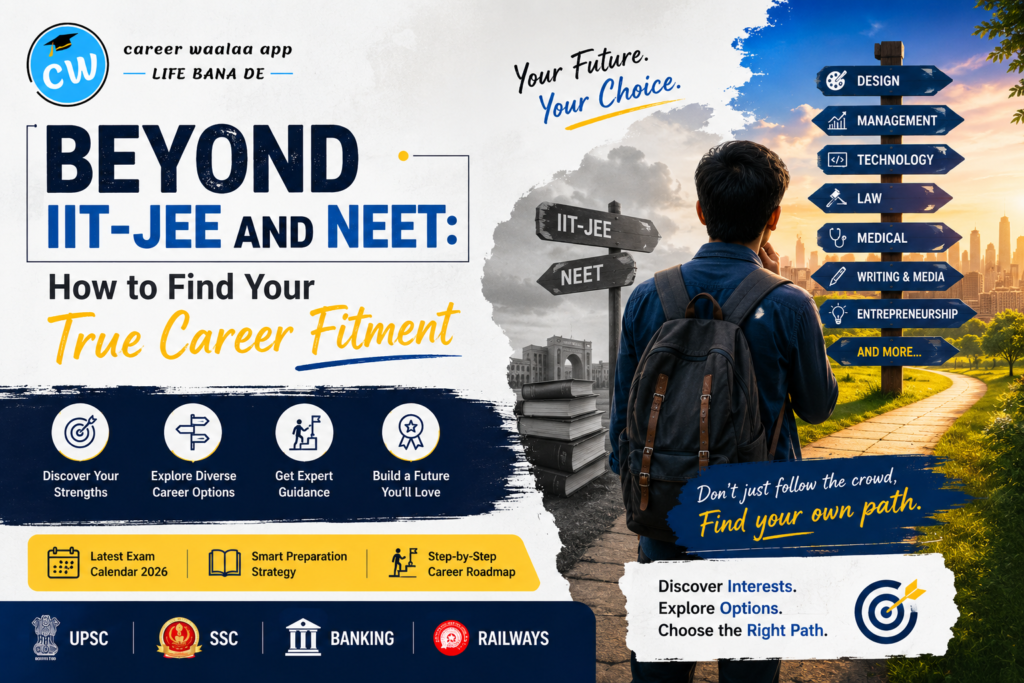
Choosing a career after Class 10 or 12 is no longer limited to preparing for IIT-JEE or NEET. While engineering and medicine remain respected options, today’s students have opportunities across technology, business, design, law, psychology, finance, media, healthcare, research and emerging fields. The real challenge is not finding a career option; it is identifying the one that genuinely fits your interests, strengths, abilities and long-term goals.
The Ministry of Education also highlights the importance of career counselling in helping students understand their interests, strengths and suitable career paths.
Why Career Fitment Matters More Than Popularity
A popular career is not automatically the right career. Students often select courses because of family expectations, peer pressure, social status or assumptions about salary. However, sustainable career growth depends on the alignment between a student’s abilities and the demands of a profession.
| Career Decision Factor | What to Evaluate |
| Interests | Subjects and activities you naturally enjoy |
| Aptitude | Areas where you learn and perform effectively |
| Personality | Work environment and responsibilities that suit you |
| Skills | Existing strengths and skills you can develop |
| Values | What matters to you in your future work |
| Career Goals | Income, growth, impact and lifestyle expectations |
A proper career fitment assessment brings these factors together instead of relying on marks or trends alone.
Look Beyond IIT-JEE and NEET
IIT-JEE and NEET are entrance pathways, not universal definitions of success. Students who do not want engineering or medicine can explore a much wider career landscape.
Emerging and Alternative Career Paths
| Interest Area | Potential Career Options |
| Technology | Software Development, AI, Cybersecurity, Data Analytics |
| Business | Management, Entrepreneurship, Finance, Marketing |
| Creativity | UI/UX Design, Animation, Content, Fashion |
| Social Sciences | Psychology, Sociology, Public Policy |
| Law | Corporate Law, Legal Research, Litigation |
| Healthcare | Physiotherapy, Nutrition, Healthcare Management |
| Media | Journalism, Advertising, Digital Media |
| Science | Research, Biotechnology, Environmental Science |
The goal should not be to choose the “best” career in general. It should be to identify the best-fit career for you.
How to Identify Your True Career Fitment
1. Understand Your Interests
Start by asking what subjects, activities and problems genuinely hold your attention. Interest does not mean choosing something simply because it feels easy. It means identifying areas where you are naturally curious and willing to learn.
2. Measure Your Aptitude
Aptitude helps identify areas in which you have the potential to learn and perform effectively. Logical reasoning, numerical ability, verbal ability, spatial understanding and other aptitude areas can provide useful direction.
NCERT’s career-counselling framework specifically recommends aptitude tests and interest inventories as tools for identifying suitable career paths.
3. Evaluate Your Personality
Your preferred way of working can influence career satisfaction. Some students enjoy structured environments, while others prefer creativity, leadership, research or working directly with people.
| Personal Preference | Careers to Explore |
| Analytical thinking | Data, Finance, Research |
| Creativity | Design, Media, Advertising |
| Helping people | Psychology, Education, Healthcare |
| Leadership | Management, Entrepreneurship |
| Technology | IT, AI, Software |
| Communication | Law, Marketing, Journalism |
These are starting points rather than fixed rules. A student’s complete profile should be considered before making a decision.
4. Match Skills With Career Requirements
Career planning should consider both current abilities and skills that can be developed. For example, someone interested in digital marketing may need communication, creativity, analytical thinking and technology skills.
The strongest career choices usually sit at the intersection of interest, aptitude, personality and opportunity.
Use Career Assessment as a Decision-Making Tool
A career assessment test can help students organize information about their interests, abilities and preferences. It should not be treated as a machine that predicts a student’s entire future.
| Assessment Area | Key Question |
| Interest | What do I enjoy learning? |
| Aptitude | What am I naturally capable of learning? |
| Personality | What working style suits me? |
| Skills | What can I already do well? |
| Values | What do I expect from my career? |
| Opportunities | Where can these strengths lead? |
A qualified career counsellor can then interpret these results and convert them into practical career options and an education roadmap.
Career Fitment Is a Process, Not a One-Time Choice
Students should avoid treating career selection as an irreversible decision. Interests and skills can evolve as students gain exposure through projects, internships, courses and real-world experiences.
A practical career planning process can look like this:
Self-assessment → Career exploration → Course research → Skill development → Practical exposure → Review and refine
This approach creates career clarity without forcing students into a decision based only on marks or social expectations.
How Career Waalaa Can Help
At Career Waalaa, career guidance focuses on helping students move from confusion to informed decision-making. A structured approach can combine career assessment, personalised counselling, career exploration and an actionable roadmap.
The objective is simple: help students understand themselves first and then explore careers that fit their individual profile.
Final Thoughts
Your career should not be defined only by the entrance exam you choose or the profession that happens to be popular around you. The right career begins with understanding who you are, what you can do, what you enjoy and where those strengths can create meaningful opportunities.
Beyond IIT-JEE and NEET lies a much broader world of possibilities. With structured career guidance, reliable assessment and informed exploration, students can move from career confusion toward a path that genuinely fits them.
FAQs
1. Is IIT-JEE or NEET necessary for a successful career?
No. They are pathways to specific professional courses. Students can build successful careers across technology, business, law, design, healthcare, research, media and many other fields.
2. What is career fitment?
Career fitment means identifying how well a career matches a student’s interests, aptitude, personality, skills, values and goals.
3. What is the best career assessment test for students?
There is no single assessment that is best for everyone. A useful assessment should evaluate relevant factors such as aptitude, interests and personality and should be interpreted in context.
4. Can career counselling help after Class 12?
Yes. Career counselling can help students compare courses, understand career requirements and create a realistic education and skill-development plan.
5. Should students choose careers based on salary?
Salary can be one consideration, but it should not be the only factor. Long-term fit, skills, interests, career growth and work preferences also matter.
6. Can my career choice change later?
Yes. Career planning is an evolving process. New experiences, education and skills can change your interests and professional direction.
7. Why is career assessment important?
Career assessment can provide structured insight into a student’s interests, aptitude and preferences, helping them explore suitable career options more systematically.
8. How can parents support career selection?
Parents can encourage exploration, listen to the student’s interests and avoid making decisions solely on marks, comparison or social pressure. Professional career guidance can also provide an objective perspective.