
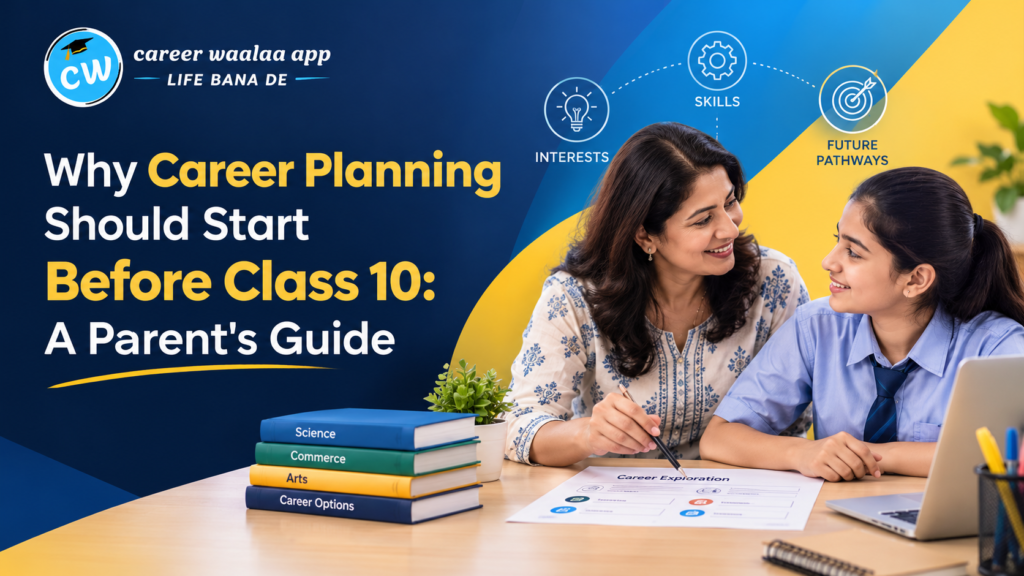
Career planning should not begin only after Class 12. By the time students reach Class 9 or 10, they are already making important academic decisions that can influence their future education and career options. Parents who introduce career awareness early can help children understand their strengths, interests, and possibilities without putting unnecessary pressure on them.
Early career planning for students is not about forcing a child to choose a profession at a young age. It is about creating awareness, identifying potential, developing the right skills, and keeping future options open.
Why Career Planning Should Start Before Class 10
Students gradually develop different interests and abilities during their school years. Early guidance allows parents to observe these changes and provide suitable opportunities.
| Reason | Benefit for Students |
| Early Self-Awareness | Students understand their strengths and interests |
| Better Subject Decisions | Academic choices become more informed |
| Career Awareness | Students learn about different professions |
| Skill Development | Important skills can be developed early |
| Reduced Confusion | Less pressure during Classes 10–12 |
| Better Academic Planning | Education goals become clearer |
What Parents Should Understand About Early Career Planning
Career planning before Class 10 should focus on exploration rather than selection. Parents do not need to decide whether their child will become a doctor, engineer, lawyer, designer, entrepreneur, or government officer.
| Instead of Doing This | Parents Should Do This |
| Force a specific career | Introduce multiple career options |
| Compare children with relatives | Understand individual strengths |
| Focus only on marks | Consider aptitude and interests |
| Choose subjects for social status | Discuss future academic requirements |
| Ignore creative interests | Encourage exploration |
| Wait until Class 12 | Start age-appropriate career discussions |
How Parents Can Identify a Child’s Strengths
A student’s marks provide useful information, but they do not show the complete picture. Parents should observe how the child learns, solves problems, communicates, and responds to different activities.
| Area to Observe | Questions Parents Can Ask |
| Academic Interest | Which subjects does the child enjoy? |
| Problem Solving | Does the child enjoy puzzles and challenges? |
| Communication | Is the child comfortable expressing ideas? |
| Creativity | Does the child enjoy drawing, writing, designing, or creating? |
| Leadership | Does the child naturally take responsibility? |
| Technology | Does the child enjoy computers and digital tools? |
| Social Skills | Does the child enjoy helping or working with others? |
Role of Career Assessment Before Class 10
A scientific career assessment test can provide useful insights into aptitude, interests, personality, and learning preferences. It should be used as a guidance tool rather than as a final decision-maker.
| Assessment Area | What It Can Reveal |
| Aptitude | Natural reasoning and problem-solving abilities |
| Interests | Preferred academic and career areas |
| Personality | Working and learning preferences |
| Skills | Existing strengths |
| Learning Style | How the student may learn effectively |
Parents can use these insights to have better conversations about education and future possibilities.
Career Exploration Ideas for Students
Career awareness becomes more effective when students experience different fields instead of simply reading about them.
| Activity | What Students Learn |
| Career Workshops | Understand different professions |
| Educational Videos | Explore unfamiliar fields |
| Skill-Based Projects | Discover practical interests |
| Competitions | Identify strengths under pressure |
| Reading Career Guides | Learn about education pathways |
| Talking to Professionals | Understand real-world careers |
| Online Quizzes | Explore aptitude and interests |
The goal is to make students curious about careers without creating anxiety about their future.
Important Academic Milestones Before Class 10
Parents should understand how career planning gradually develops throughout school.
| Class | Career Planning Focus |
| Class 6–7 | Explore interests and basic skills |
| Class 8 | Identify strengths and activity preferences |
| Class 9 | Understand academic subjects and career areas |
| Class 10 | Explore stream options and future pathways |
| Class 11–12 | Build focused academic and entrance-exam plans |
This approach gives students enough time to understand their options before making major academic decisions.
Choosing the Right Stream After Class 10
Stream selection is one of the first major academic decisions students make. Parents should consider multiple factors instead of choosing a stream based only on marks or social expectations.
| Stream | Common Career Areas |
| Science | Medicine, Engineering, Research, Technology |
| Commerce | Finance, Accounting, Business, Management |
| Humanities | Law, Psychology, Journalism, Civil Services |
| Vocational | Technical Skills, Design, Healthcare, Services |
A student’s interests, aptitude, academic performance, and long-term goals should all be considered together.
Common Career Planning Mistakes Parents Should Avoid
Good intentions can sometimes create unnecessary pressure. Parents should avoid making career planning stressful.
| Mistake | Better Approach |
| Comparing with other children | Track individual progress |
| Choosing careers based on trends | Research career suitability |
| Focusing only on salary | Consider interest, skills, and opportunities |
| Ignoring changing career options | Explore emerging professions |
| Making decisions without the child | Involve the student |
| Treating one test as final | Combine assessment with observation |
How Technology Can Support Career Planning
Digital tools can make career exploration easier when used appropriately. Online assessments, educational resources, quizzes, and learning platforms allow students to understand their interests and practice different skills.
| Digital Resource | Possible Use |
| Online Career Assessment | Identify interests and aptitude |
| Free Online Quizzes | Develop self-awareness |
| Learning Platforms | Explore new subjects |
| Digital Libraries | Research career options |
| Practice Tests | Understand academic strengths |
| Career Information Resources | Compare education pathways |
Technology should support parental guidance rather than replace meaningful conversations.
A Simple Career Planning Roadmap for Parents
Parents can follow a gradual approach instead of trying to solve everything at once.
| Stage | Parent’s Action | Student’s Role |
| Exploration | Introduce different careers | Ask questions |
| Assessment | Identify aptitude and interests | Participate honestly |
| Research | Explore education pathways | Compare options |
| Skill Building | Provide learning opportunities | Practice regularly |
| Class 10 | Discuss stream choices | Express preferences |
| Classes 11–12 | Develop focused goals | Work toward goals |
How Career Waalaa Can Help Students
Career planning becomes more effective when assessment, learning, and regular practice work together. Career Waalaa can support students through career-oriented assessments, quizzes, study resources, and test preparation tools.
| Career Support | Student Benefit |
| Career Assessment | Better understanding of strengths |
| Online Quizzes | Regular self-evaluation |
| Mock Tests | Academic practice |
| Study Material | Structured learning |
| Current Affairs Practice | Better general awareness |
| Performance Analysis | Identify areas for improvement |
Parents can use these resources to encourage informed decision-making while allowing students to remain actively involved in their own career journey.
FAQs
1. When should parents start career planning for their child?
Career awareness can begin before Class 10. At this stage, the focus should be on exploring interests, identifying strengths, and understanding different career options rather than choosing one profession.
2. Should students choose their career before Class 10?
No. Students do not need to finalize a career before Class 10. Early planning should help them explore possibilities and prepare for future academic decisions.
3. Is a career assessment test useful for school students?
Yes. A suitable assessment can provide insights into aptitude, interests, personality, and strengths that may support better educational and career discussions.
4. How can parents identify their child’s career interests?
Parents can observe academic preferences, hobbies, problem-solving abilities, communication skills, creativity, and the activities that naturally attract the child’s attention.
5. Should parents decide which stream their child should choose?
Parents should guide rather than impose the decision. The student’s interests, aptitude, academic performance, and future goals should all be considered.
6. What mistakes should parents avoid during career planning?
Parents should avoid comparisons, excessive pressure, choosing careers only because they are popular, and assuming that high marks automatically determine the right career.
7. Can career planning reduce confusion after Class 10?
Yes. Early exploration helps students understand different options before they have to make important academic decisions, making the transition after Class 10 more informed.
8. What is the main goal of career planning before Class 10?
The main goal is to develop self-awareness and career awareness so students can make better academic and career decisions as they grow.