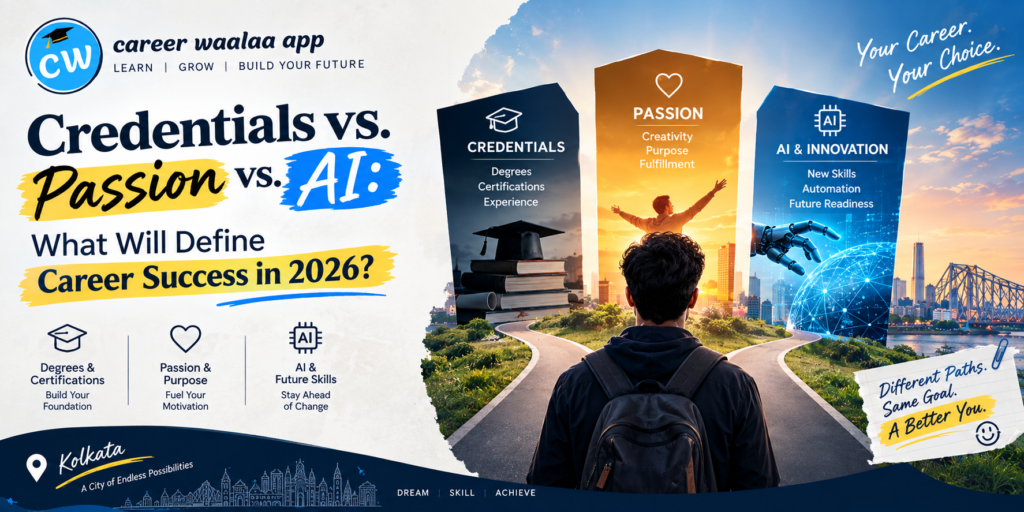
Career success in 2026 is no longer defined by a single degree, a prestigious college or simply choosing a profession you love. Artificial intelligence is changing how work gets done, employers are placing greater emphasis on practical capabilities, and students are discovering that passion alone does not automatically create a successful career.
So what matters most: credentials, passion or AI skills?
The answer is more balanced than choosing one over the others. In today’s changing job market, career success increasingly depends on combining a credible educational foundation with genuine interests, practical skills, adaptability and the ability to use technology effectively.
Are Traditional Credentials Still Important?
Degrees, diplomas and professional qualifications continue to matter, particularly for careers where formal education and licensing are essential. A recognised qualification can provide foundational knowledge, demonstrate commitment and meet eligibility requirements for specific professions.
However, a credential by itself may not demonstrate whether someone can apply what they have learned.
Recent discussion around India’s higher education system highlights this distinction: degrees remain important, but employers increasingly need stronger evidence of practical capability.
| Credential Provides | Credential Alone May Not Show |
| Academic foundation | Practical problem-solving |
| Subject knowledge | Real-world application |
| Eligibility for professions | Adaptability |
| Structured learning | Portfolio quality |
| Formal qualification | AI readiness |
This means students should not abandon education. Instead, they should focus on education plus capability.
Does Passion Still Matter in 2026?
Absolutely—but passion should be understood realistically.
Passion can create curiosity, motivation and willingness to keep learning. A student who genuinely enjoys solving problems may be more willing to develop expertise in that area than someone who chooses it purely because it appears profitable.
However, passion should not be the only basis for a career decision.
Passion Needs Direction
| Passion Without Planning | Passion With Career Planning |
| “I like technology.” | “Which technology career fits me?” |
| “I love writing.” | “Which writing-related roles match my strengths?” |
| “I enjoy design.” | “Should I explore UI/UX, branding or another design field?” |
| “I like business.” | “Which business skills should I develop?” |
The goal is to connect interests with aptitude, skills, education requirements and real career opportunities.
AI Is Changing the Definition of Career Readiness
Artificial intelligence is perhaps the biggest new factor in career planning.
The World Economic Forum’s Future of Jobs research identifies AI and big data among the fastest-growing skills, alongside networks and cybersecurity and technological literacy. It also highlights creative thinking, resilience, flexibility, agility, curiosity and lifelong learning as increasingly important.
AI therefore should not be viewed only as a threat to jobs. It is also changing the skills people need to perform those jobs effectively.
| Traditional Focus | 2026 Career Focus |
| Memorising information | Applying knowledge |
| One-time qualification | Continuous learning |
| Basic digital literacy | AI and technology literacy |
| Performing repetitive tasks | Solving complex problems |
| Working without technology | Working effectively with AI |
| Degree as the final milestone | Skills development as an ongoing process |
The New Career Success Formula
Career success in 2026 is better understood as a combination of several factors.
Career Success = Credentials + Skills + Passion + AI Literacy + Adaptability
No single component is enough.
Credentials
Provide educational foundations and, in many fields, professional eligibility.
Passion
Provides motivation and helps students identify areas they are genuinely interested in exploring.
Practical Skills
Demonstrate that knowledge can be converted into useful outcomes.
AI Literacy
Helps professionals understand how AI can support research, analysis, communication, productivity and problem-solving.
Adaptability
Allows people to continue learning as technologies and job requirements change.
Which Skills Will Matter Most?
The World Economic Forum’s research places analytical thinking at the top of its list of core skills, followed by resilience, flexibility and agility, leadership and social influence, creative thinking, and motivation and self-awareness.
| Skill | Why It Matters |
| Analytical Thinking | Helps solve complex problems |
| Creative Thinking | Supports innovation and new ideas |
| AI Literacy | Helps professionals work with emerging technology |
| Communication | Enables effective collaboration |
| Adaptability | Supports continuous career development |
| Leadership | Helps manage people and decisions |
| Curiosity | Encourages lifelong learning |
| Problem-Solving | Converts knowledge into practical outcomes |
This combination is important because AI can increasingly assist with routine tasks, while human judgement, creativity, collaboration and decision-making remain valuable.
Should Students Choose an AI Career?
Not necessarily.
One of the biggest mistakes students can make in 2026 is choosing AI simply because it is trending.
A better approach is to ask:
- Do I enjoy technology and problem-solving?
- What does my aptitude indicate?
- What type of work environment suits my personality?
- Which careers connect with my interests?
- What skills does the industry require?
- How can AI be used within my chosen field?
AI is becoming relevant across many industries, including marketing, finance, healthcare, design, education, business and research.
Therefore, students do not necessarily need an “AI career.” They need to understand how AI affects the career they choose.
How Career Counselling Can Help
The growing number of career choices can make decision-making more complicated. A structured career counselling process can help students evaluate their interests, aptitude, personality, skills and long-term goals.
| Career Question | What to Evaluate |
| What do I enjoy? | Interests |
| What am I capable of learning? | Aptitude |
| How do I prefer to work? | Personality |
| What can I do today? | Skills |
| What qualifications are required? | Credentials |
| How is AI changing this field? | Future readiness |
| What should I learn next? | Career roadmap |
This creates a more personalised approach to career planning instead of choosing a profession based only on marks, social pressure or current trends.
What Students Should Do in 2026
Students can prepare for the changing job market by following a practical approach:
Build a Strong Educational Foundation
Choose an appropriate degree, diploma or professional qualification based on your intended career.
Develop Practical Skills
Projects, practical assignments and relevant experiences can help turn theoretical knowledge into capabilities.
Learn AI Fundamentals
Students from different fields can develop basic AI literacy and understand how AI tools are being used in their area.
Follow Your Genuine Interests
Explore subjects and activities that naturally create curiosity, but validate them through aptitude, research and practical exposure.
Keep Learning
A qualification should be viewed as a foundation rather than the end of learning.
How Career Waalaa Can Help
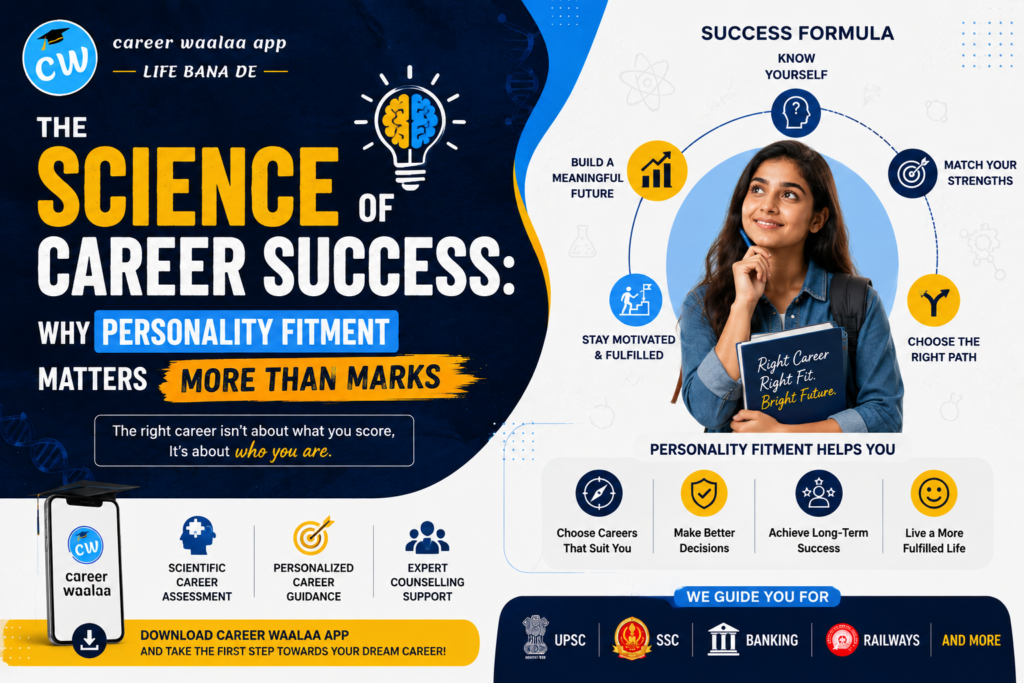
Career Waalaa helps students approach career decisions through structured career assessment, career counselling and personalised career planning.
Instead of asking students to choose between credentials, passion and technology, the focus should be on understanding how these factors work together.
The objective is to identify a career direction that matches the student’s interests, aptitude, personality and goals while also considering the changing demands of the future workplace.
Final Thoughts
The career question in 2026 is not credentials vs. passion vs. AI. It is how effectively you can combine all three.
A qualification can provide the foundation. Passion can provide motivation. Practical skills can demonstrate capability. AI literacy can improve productivity and relevance. Adaptability can help you continue growing when the workplace changes.
For students planning their future, the smartest strategy is not to predict exactly which jobs will dominate the next decade. It is to build the knowledge, skills, self-awareness and learning ability that allow them to adapt.
The future belongs less to people who simply have credentials or passion and more to those who can continuously turn knowledge, curiosity and technology into meaningful value.
FAQs
1. Are degrees still important for career success in 2026?
Yes. Degrees remain important for many careers and can provide foundational knowledge and professional eligibility. However, practical skills and evidence of capability are increasingly important alongside qualifications.
2. Is passion enough to build a successful career?
No. Passion can provide motivation, but career success also requires relevant skills, education, practical experience, adaptability and an understanding of career opportunities.
3. Will AI replace traditional careers?
AI is changing many tasks and job functions, but the impact differs across occupations. The more useful approach for students is to understand how AI is changing their chosen field and develop complementary skills.
4. Should every student learn AI?
Basic AI and technology literacy can be useful across many fields. However, the depth of AI learning should depend on the student’s career direction.
5. What skills are most important for future careers?
Analytical thinking, creative thinking, adaptability, technological literacy, communication, leadership and lifelong learning are among the skills highlighted in current future-of-work research.
6. How can students balance passion and career opportunities?
Students can identify their interests first and then evaluate them against aptitude, education requirements, skill demands and employment opportunities.
7. Is career counselling useful in the AI era?
Yes. Career counselling can help students understand their individual profiles and evaluate how emerging technologies may affect different career pathways.
8. What is the biggest career mistake students can make in 2026?
Choosing a career based entirely on one factor—such as marks, salary, family expectations, passion or an AI trend—can lead to poor fit. A broader assessment provides a more informed basis for decision-making.