
Choosing a career can feel overwhelming, especially when students have too many options and too little clarity. After Class 10 or 12, decisions about subjects, courses, entrance exams and future careers can create significant pressure. Sometimes, searching online or asking friends and relatives is not enough.
This is where professional career counselling can provide structured guidance. A qualified career counsellor can help students understand their interests, aptitude, personality, strengths and goals before they make important education and career decisions.
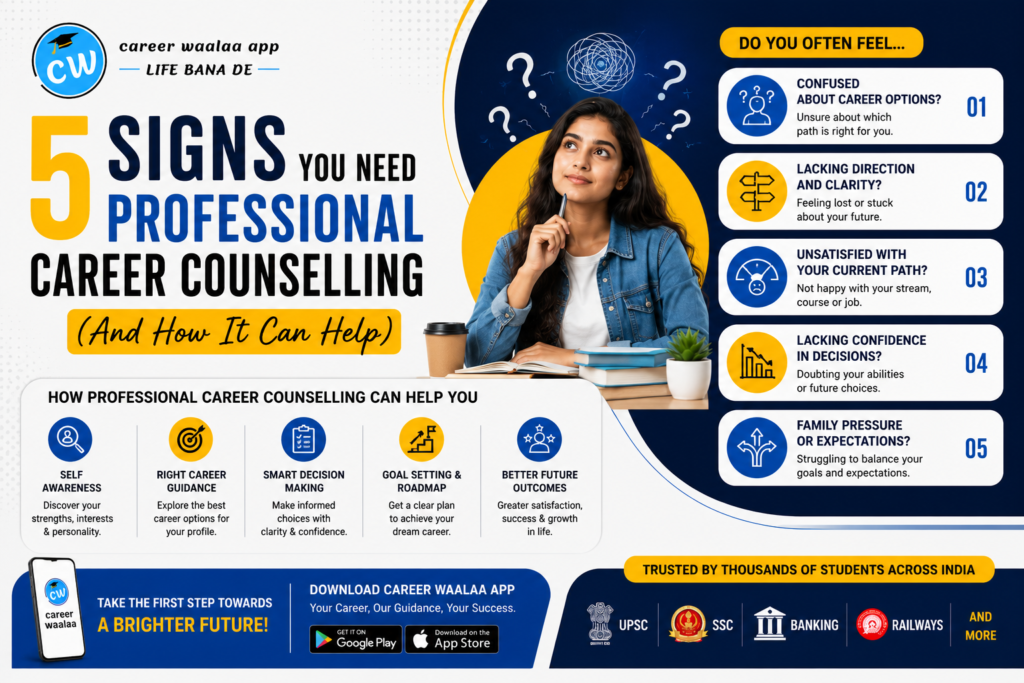
But how do you know when career counselling is actually needed? Here are five common signs.
What Is Professional Career Counselling?
Professional career counselling is a structured process that helps individuals understand themselves and evaluate suitable educational and career pathways.
Instead of recommending a career based only on marks, a good counselling process considers multiple factors.
| Career Factor | What It Helps Understand |
| Interests | Subjects and activities you enjoy |
| Aptitude | Areas where you may have natural potential |
| Personality | Preferred working and learning styles |
| Skills | Existing capabilities and development areas |
| Values | What matters to you professionally |
| Goals | Long-term education and career expectations |
The purpose is not to make the decision for a student. It is to provide clarity so the student can make a more informed decision.
5 Signs You Need Career Counselling
1. You Have No Clear Career Direction
One of the strongest signs is simply not knowing what you want to pursue.
You may have considered engineering, medicine, management, law, design, psychology, technology or other fields but cannot decide which direction suits you.
Having multiple interests is not necessarily a problem. The challenge is understanding how those interests connect with your abilities and realistic career opportunities.
A career counselling session can help organise these options and create a structured path for exploration.
2. You Are Choosing a Career Because of Pressure
Students can experience pressure from parents, relatives, friends, teachers or social expectations. Sometimes a particular profession is considered successful simply because it is popular.
For example, a student may choose a course because friends are choosing it or because a particular profession is perceived as prestigious.
| Decision Driver | Potential Problem |
| Family pressure | Personal interests may be ignored |
| Peer influence | Career choice may follow friends |
| Social status | Reality of the profession may be overlooked |
| Salary alone | Job fit and satisfaction may be ignored |
| Marks alone | Personality and interests may not be considered |
Professional career guidance can introduce a more objective approach based on the student’s individual profile.
3. Your Marks and Interests Do Not Match
Good marks do not automatically mean that a particular career is suitable.
A student might score highly in mathematics but have a stronger interest in communication, business or creative work. Another student might perform moderately in a subject but demonstrate strong curiosity and motivation in that area.
This is why career assessment can be useful.
Look Beyond Academic Performance
| What You Know | What You Should Also Explore |
| Your marks | Your aptitude |
| Favourite subjects | Your broader interests |
| Exam performance | Your learning preferences |
| Strong subjects | Your personality |
| Academic achievements | Your long-term goals |
The goal is to find the intersection between what you enjoy, what you can develop and what career opportunities are available.
4. You Are Confused About Courses and Career Options
The number of courses and career pathways has expanded considerably. Technology, artificial intelligence, digital business, healthcare management, psychology, design and specialised professional fields have created opportunities beyond traditional choices.
However, more options can sometimes create more confusion.
A career assessment test combined with professional counselling can help students compare options systematically.
| Question | Why It Matters |
| What does the course teach? | Understand the academic pathway |
| What skills are required? | Check personal compatibility |
| What careers can follow? | Understand possible outcomes |
| What further education is needed? | Plan long-term |
| What work environments exist? | Evaluate personality fit |
This approach helps students move from random career searching to informed career exploration.
5. You Are Making a Major Education Decision
Career counselling can be particularly useful before important decisions such as selecting subjects after Class 10, choosing a stream after Class 10, selecting a degree after Class 12 or considering a change in academic direction.
These decisions can influence future opportunities, so gathering reliable information beforehand can be valuable.
How Career Counselling Can Help
Professional counselling is not simply about receiving a list of careers. A structured process can help students understand themselves and explore appropriate pathways.
Step 1: Self-Assessment
The process can begin by examining interests, aptitude, personality, skills and values.
Step 2: Career Exploration
Students can then explore careers that align with their profile and understand the qualifications and skills required.
Step 3: Course and College Planning
Once potential directions are identified, students can compare relevant courses, eligibility requirements and educational pathways.
Step 4: Create a Career Roadmap
The final stage is developing practical next steps.
Self-awareness → Assessment → Career exploration → Course selection → Skill development → Career roadmap
Career Counselling vs Making the Decision Alone
| Without Structured Guidance | With Professional Guidance |
| Too many disconnected options | Organised career choices |
| Reliance on social pressure | Individual profile-based exploration |
| Random online research | Structured information |
| Focus mainly on marks | Broader assessment |
| Short-term thinking | Long-term career roadmap |
Professional guidance does not remove the student’s responsibility. Instead, it helps the student make decisions with better information.
How Career Waalaa Can Help
Career Waalaa provides structured career counselling for students designed to help them move from confusion toward clarity.
Through career assessment, personalised counselling and career exploration, students can better understand their strengths, interests and potential pathways. The focus is on creating an informed career roadmap rather than recommending a one-size-fits-all profession.
For students and parents facing uncertainty about the next academic or career step, professional guidance can provide a clearer framework for decision-making.
Final Thoughts
Career confusion is not a sign that you are failing to plan your future. It often means you need better information and a clearer understanding of yourself.
If you are struggling to choose a direction, feeling pressured by others, confused about courses or unsure how your strengths translate into careers, professional career counselling can be a valuable starting point.
The right career decision begins with understanding yourself not simply following what everyone else is doing
FAQs
1. When should a student consider career counselling?
Students can consider counselling when they feel confused about career options, face pressure from others, cannot connect their interests with suitable careers or are approaching an important academic decision.
2. Is career counselling only for students with low marks?
No. Students with high, average or low marks can benefit from career guidance. Academic performance is only one part of career planning.
3. What does a career counsellor do?
A career counsellor helps students understand their interests, aptitude, personality, skills and goals and then explore suitable education and career pathways.
4. Can career counselling help after Class 12?
Yes. It can help students compare degree programmes, career options, specialisations and potential professional pathways.
5. Is a career assessment test enough to choose a career?
No. Assessment results are most useful when interpreted alongside the student’s interests, academic background, goals and real-world career information.
6. Can parents participate in career counselling?
Yes. Parent involvement can be helpful, particularly when discussing education plans, expectations and practical considerations. However, the student’s interests and goals should remain central.
7. What if I have several career interests?
That is common. Career counselling can help compare those interests based on aptitude, personality, education requirements and career opportunities.
8. Does career counselling guarantee career success?
No counselling process can guarantee a particular outcome. Its purpose is to improve clarity, decision-making and career planning through structured guidance.