
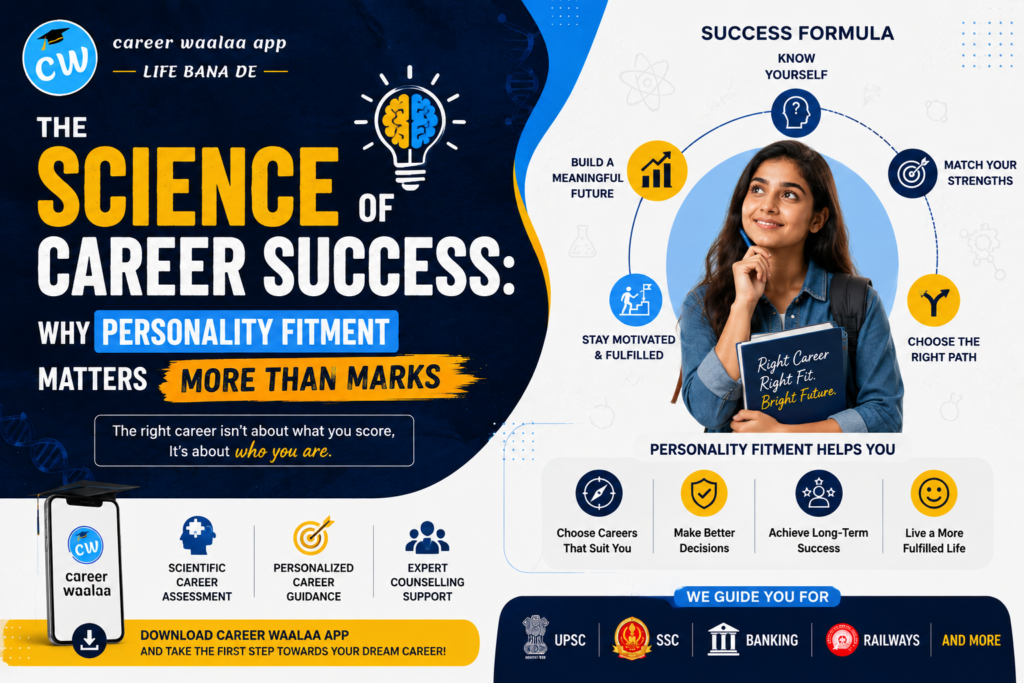
Marks can open doors, but they do not always determine whether a student will enjoy, sustain, or succeed in a particular career. Academic performance measures certain aspects of learning, while career success depends on a much broader combination of abilities, interests, personality, motivation, values and adaptability.
This is why personality fitment has become an important part of modern career planning. Understanding how a student’s natural preferences align with different work environments can help create more informed career decisions and reduce the risk of choosing a path simply because it is popular or academically prestigious.
What Is Personality Fitment in Career Planning?
Personality fitment refers to the alignment between an individual’s behavioural preferences, working style, interests and the characteristics of a potential career.
For example, two students may achieve similar marks but have completely different preferences. One may enjoy analysing data independently, while another may thrive through communication and collaboration. Their suitable career environments could therefore be very different.
| Career Factor | What It Reveals |
| Personality | Preferred working and interaction style |
| Interests | Areas that naturally attract attention |
| Aptitude | Potential to learn specific types of tasks |
| Values | What matters in professional life |
| Skills | Current capabilities |
| Motivation | What encourages sustained effort |
A reliable career assessment considers multiple factors rather than treating marks as the complete picture.
Why Marks Alone Cannot Predict Career Success
Academic marks are valuable, but they represent only one dimension of a student’s profile. A high score in a subject does not necessarily mean that the student will enjoy working in a profession related to that subject.
Academic Performance vs Career Fit
| Marks Can Indicate | Marks Cannot Fully Indicate |
| Academic performance | Long-term career interest |
| Subject understanding | Preferred work environment |
| Exam preparation ability | Personality compatibility |
| Knowledge retention | Professional motivation |
| Performance under academic conditions | Workplace satisfaction |
A student may score highly in mathematics but prefer careers involving people, creativity or entrepreneurship. Another student may have average marks but demonstrate strong communication, leadership, problem-solving and creative abilities.
Therefore, career planning should look beyond report cards.
The Science Behind Personality and Career Choice
Career psychology has long explored the relationship between personality characteristics and vocational interests. One influential framework is Holland’s theory of vocational choice, which groups people and work environments into six broad categories: Realistic, Investigative, Artistic, Social, Enterprising and Conventional.
These categories can help students understand why certain environments feel more natural to them.
| Personality Orientation | Possible Career Areas |
| Investigative | Research, Data, Science, Technology |
| Artistic | Design, Writing, Media, Creative Fields |
| Social | Teaching, Psychology, Counselling, Healthcare |
| Enterprising | Business, Sales, Management, Entrepreneurship |
| Conventional | Finance, Administration, Operations |
| Realistic | Engineering, Technical, Practical Careers |
These categories should be used for exploration rather than as rigid labels. People can have characteristics from several areas.
How Personality Fitment Improves Career Decisions
1. It Creates Better Self-Awareness
Students often know what subjects they study but may not know how they prefer to work. Personality assessment can encourage them to examine their communication style, decision-making preferences, collaboration habits and working environment preferences.
2. It Helps Identify Suitable Work Environments
Career satisfaction is influenced not only by the job title but also by the environment.
Some individuals may prefer structured workplaces, while others may perform better when given independence and creative freedom.
3. It Reduces Career Mismatch
Choosing a career entirely because of marks, family expectations or social pressure can result in poor fit. Understanding personality before selecting a course can help students explore alternatives more objectively.
Personality Fitment and Aptitude Are Not the Same
A common mistake is treating personality and aptitude as identical. They answer different questions.
| Assessment | Main Question |
| Personality | How do I naturally prefer to behave and work? |
| Aptitude | What types of tasks may I learn effectively? |
| Interest | What subjects or activities attract me? |
| Values | What do I want from my career? |
| Skills | What can I currently do? |
The strongest career fitment assessment combines these dimensions instead of depending on one test.
From Career Assessment to Career Roadmap
A personality assessment should be the beginning of exploration, not the final answer.
A practical process can follow these stages:
Self-assessment → Personality profiling → Aptitude evaluation → Career exploration → Course comparison → Skill development → Career roadmap
For example, a student interested in technology could explore software development, cybersecurity, data analytics, UI/UX, product management and other technology-related roles. Personality and aptitude can help narrow the options based on individual preferences.
What Parents Should Understand About Marks
Parents naturally want their children to perform well academically. However, career decisions should not become a competition based solely on percentages.
Instead of asking only, “What marks did you get?”, parents can also ask:
- What subjects do you enjoy?
- What type of problems do you like solving?
- Do you prefer working independently or with others?
- What activities make you curious?
- What kind of work environment interests you?
- What careers would you like to explore?
These questions can create more meaningful conversations about future planning.
How Career Waalaa Supports Better Career Decisions
Career Waalaa focuses on helping students move beyond marks-based career selection through structured career counselling, assessment and personalised guidance.
By examining personality, aptitude, interests and career preferences together, students can explore career paths that align more closely with their individual profiles. The goal is not to tell every student which career to choose, but to help them understand their options and make informed decisions.
Final Thoughts
Career success is not determined by a single percentage, examination or personality trait. Marks provide useful academic information, but they are only one part of a much larger career picture.
When students understand their personality, aptitude, interests, values and skills, they can make career decisions based on fit rather than pressure or comparison. That is the real science behind effective career planning: know yourself first, then choose where your strengths can take you.
FAQs
1. Is personality more important than marks for career success?
Personality should not be considered more important in every situation. Marks, aptitude, skills, interests and personality all provide different information and should be considered together.
2. What is personality fitment?
Personality fitment is the process of understanding how an individual’s behavioural preferences and working style align with potential careers and professional environments.
3. Can high marks guarantee career success?
No. Academic performance can be valuable, but long-term career success also involves skills, motivation, adaptability, interests, personality and continuous learning.
4. What is a career fitment assessment?
A career fitment assessment evaluates factors such as interests, aptitude, personality and preferences to help students explore suitable career directions.
5. When should students take a personality assessment?
Students can explore personality and career assessments during secondary school, higher secondary education or before choosing a college course. Earlier exploration can provide more time for informed decision-making.
6. Can personality change over time?
Some personality characteristics can remain relatively stable while others may develop through experiences and maturity. Career assessments should therefore be viewed as guidance rather than permanent labels.
7. Should parents choose careers based on marks?
Marks should be considered, but they should not be the only basis for career decisions. A student’s interests, abilities, personality and goals also deserve attention.
8. How does career counselling help students?
Career counselling can help students understand their profiles, explore suitable career options, compare educational pathways and develop a practical career plan.